9.9 - Type III Evacuation Requirements
Module: Type III Low-Pressure Appliances
Regulatory verification date: August 13, 2026
Primary current authority: 40 CFR § 82.156 and current EPA Section 608 service-practice / Type III test-topic guidance
Course role: Establishes the current federal evacuation requirement for low-pressure appliances, explains the meaning of 25 mm Hg absolute, distinguishes normal, non-major, and leaking-appliance conditions, and teaches how to interpret pressure rise after the required recovery level is reached
Learning Objectives
After completing this section, a student should be able to:
- State the current Section 608 evacuation requirement for a low-pressure appliance.
- Explain why the requirement is expressed as 25 mm Hg absolute rather than inches of mercury vacuum.
- Distinguish absolute pressure from gauge pressure and vacuum indication.
- Explain why the 25 mm Hg absolute requirement is the same when using recovery/recycling equipment manufactured or imported before or on/after November 15, 1993.
- Explain why refrigerant charge below or above 200 pounds does not change the current low-pressure row of the evacuation table.
- Explain the requirement to verify that the applicable evacuation level has been reached before the appliance or isolated portion is opened.
- Explain why technicians should wait a few minutes after reaching the required recovery vacuum and observe whether pressure rises.
- Identify remaining liquid refrigerant and refrigerant dissolved in oil as important causes of pressure rebound during Type III recovery.
- Explain how moisture, outgassing, or leakage can also affect vacuum behavior during post-service evacuation/dehydration.
- Distinguish major from non-major maintenance, service, or repair under current Section 608 definitions.
- Explain the limited current non-major low-pressure exception that permits pressurization to no higher than 0 psig before opening when all regulatory conditions are satisfied.
- Explain the current leaking-appliance exception requiring isolation where possible and evacuation of a leaking component to the lowest attainable level, not above 0 psig, when the prescribed level cannot be reached without substantial contamination.
- Explain why a temporary gauge reading at the required value does not by itself prove that recovery is complete.
- Apply the current low-pressure evacuation requirement to service, repair, and disposal scenarios without using historical or Type II values.
Introduction
Low-pressure appliances have a current Section 608 evacuation requirement that is different in both value and units from the requirements used for medium- and high-pressure appliances.
For a low-pressure appliance, the current required level is:
25 mm Hg ABSOLUTE
This requirement appears in both columns of the current federal evacuation table:
Recovery/recycling equipment manufactured or imported
BEFORE November 15, 1993
→ 25 mm Hg absolute
and:
Recovery/recycling equipment manufactured or imported
ON OR AFTER November 15, 1993
→ 25 mm Hg absolute
Therefore, the most important Type III table relationship is:
LOW-PRESSURE APPLIANCE
→ 25 mm Hg ABSOLUTE
→ SAME REQUIREMENT FOR BOTH EQUIPMENT-DATE COLUMNS
The unit is critical.
The rule does not say:
25 inches Hg vacuum
It says:
25 millimeters Hg absolute
That is an absolute-pressure value very near a deep vacuum.
The technician must also understand what happens after the required recovery level is reached.
EPA’s current Type III test topics specifically require technicians to know that they should:
WAIT A FEW MINUTES
after reaching the required recovery vacuum
and determine whether:
SYSTEM PRESSURE RISES
A pressure rise can indicate that refrigerant remains as:
- Liquid somewhere in the appliance.
- Refrigerant dissolved in oil.
In broader vacuum/dehydration diagnosis, pressure rise can also be influenced by:
- Moisture.
- Outgassing.
- Leakage.
These possibilities must be interpreted carefully rather than treating every pressure rise as proof of one specific problem.
This section also distinguishes the normal 25 mm Hg absolute requirement from two important exceptions:
- A limited non-major repair provision.
- A leaking-appliance provision when the prescribed evacuation level cannot be attained.
Key Concepts
1. Current Low-Pressure Evacuation Requirement
The current Section 608 Table 1 requirement for a low-pressure appliance is:
25 mm Hg absolute
This value applies to:
- Recovery/recycling equipment manufactured or imported before November 15, 1993.
- Recovery/recycling equipment manufactured or imported on or after November 15, 1993.
The current table does not divide the low-pressure row by:
- Charge below 200 pounds.
- Charge at or above 200 pounds.
Those charge distinctions appear in certain Type II rows, not the low-pressure row.
High-Priority Type III Rule
LOW-PRESSURE APPLIANCE
→ 25 mm Hg ABSOLUTE
Understanding 25 mm Hg Absolute
1. “Absolute” Means Measured From Perfect Vacuum
Absolute pressure uses:
0 absolute pressure
as its reference.
Therefore:
25 mm Hg absolute
means the system pressure is only 25 millimeters of mercury above perfect vacuum.
It does not mean the system is 25 mm Hg below atmospheric pressure.
2. Do Not Confuse Millimeters With Inches
The current low-pressure requirement is:
25 mm Hg absolute
not:
25 in. Hg vacuum
These are very different values.
Because:
25.4 mm = 1 inch
the required value is approximately:
25 mm Hg absolute
≈ 0.98 in. Hg absolute
At the table’s standard atmospheric reference of approximately 29.9 in. Hg, that corresponds roughly to:
29.9 - 0.98
≈ 28.9 in. Hg vacuum
This conversion is only a teaching aid.
The controlling federal requirement remains:
25 mm Hg ABSOLUTE
3. Why Absolute Pressure Is Appropriate for Low-Pressure Appliances
Low-pressure chillers normally operate below atmospheric pressure in portions of their operating range.
Gauge pressure can therefore be negative relative to atmosphere.
Absolute pressure avoids ambiguity.
The pressure scale can be visualized as:
PERFECT VACUUM
0 mm Hg absolute
│
│
25 mm Hg absolute ← CURRENT TYPE III REQUIRED LEVEL
│
│
ATMOSPHERIC PRESSURE
≈ 760 mm Hg absolute
Absolute pressure is especially useful because the boiling and saturation behavior of refrigerants depends fundamentally on absolute pressure.
Current Low-Pressure Row of the Evacuation Table
1. Recovery-Equipment Date Does Not Change the Type III Value
The federal table separates recovery/recycling equipment into two date categories:
| Recovery/Recycling Equipment | Low-Pressure Appliance Requirement |
|---|---|
| Manufactured or imported before November 15, 1993 | 25 mm Hg absolute |
| Manufactured or imported on or after November 15, 1993 | 25 mm Hg absolute |
Important Date Distinction
The November 15, 1993 date refers to the:
RECOVERY / RECYCLING EQUIPMENT
not the:
CHILLER MANUFACTURE DATE
This is a common examination trap.
2. Charge Size Does Not Change the Low-Pressure Row
Some medium- and high-pressure rows depend on whether the appliance or isolated component has:
LESS THAN 200 lb
or:
200 lb OR MORE
The low-pressure row does not.
Therefore:
LOW-PRESSURE APPLIANCE
50 lb charge
→ 25 mm Hg absolute
and:
LOW-PRESSURE APPLIANCE
500 lb charge
→ 25 mm Hg absolute
under the normal Table 1 condition.
Do not import a Type II 200 lb distinction into the Type III low-pressure row.
When the Table 1 Requirement Applies
For appliances covered by the normal rule, technicians must recover refrigerant before:
- Opening the appliance for maintenance.
- Opening the appliance for service.
- Opening the appliance for repair.
- Disposal.
Current § 82.156 also permits the technician to evacuate:
the entire appliance
or:
the part being serviced
if the refrigerant in the part can be isolated to a system receiver.
The applicable evacuation level must be verified in the appliance or part before it is opened.
Important Relationship
ISOLATE SERVICE PORTION
when permitted
↓
EVACUATE THAT PORTION
TO THE APPLICABLE LEVEL
↓
VERIFY LEVEL
↓
OPEN FOR SERVICE
Waiting and Monitoring After Reaching 25 mm Hg Absolute
1. Reaching the Number Is Not the Final Diagnostic Step
EPA’s current Type III test topics require technicians to know the need to:
WAIT A FEW MINUTES
after reaching the required recovery vacuum
and then observe whether pressure rises.
This is important because the pressure can temporarily reach the required value while refrigerant still remains elsewhere inside the chiller.
2. Why Pressure Can Rise After Recovery Is Stopped
When the recovery machine is operating, it continuously removes refrigerant vapor.
When it is stopped or isolated as directed:
refrigerant remaining inside appliance
can continue to vaporize
That vapor increases pressure.
Possible refrigerant sources include:
- Residual liquid in a low point.
- Refrigerant trapped in internal passages.
- Refrigerant dissolved in compressor oil.
- Refrigerant films on internal surfaces.
EPA’s Type III exam cue specifically emphasizes:
LIQUID REFRIGERANT
or
REFRIGERANT IN OIL
as reasons for pressure rise after the required recovery vacuum has been reached.
3. Correct Response to Refrigerant Pressure Rebound
If pressure rises because additional refrigerant is becoming vapor:
PRESSURE RISE
→ REFRIGERANT MAY REMAIN
→ CONTINUE / RESUME RECOVERY AS REQUIRED
Do not treat the first momentary achievement of 25 mm Hg absolute as automatic proof that refrigerant recovery is complete.
Moisture and Pressure Rise
1. Moisture Can Affect Vacuum Behavior
After a refrigerant circuit has been opened for service, moisture can remain on:
- Internal metal surfaces.
- Oil.
- Filter-drier material.
- Deposits.
- Internal component surfaces.
Under vacuum, moisture can evaporate or boil.
That water vapor contributes to system pressure.
A simplified relationship is:
MOISTURE REMAINS
↓
water evaporates under vacuum
↓
vapor enters system space
↓
pressure rises
2. Recovery Endpoint Versus Dehydration Quality
The Section 608 value:
25 mm Hg absolute
is a refrigerant-removal requirement for the applicable low-pressure appliance condition.
It is not automatically a complete technical dehydration specification for every repaired chiller.
After service, manufacturer procedures can require additional evacuation/dehydration work to remove:
- Air.
- Water vapor.
- Other noncondensables.
Do not confuse:
EPA REFRIGERANT-REMOVAL ENDPOINT
with:
MANUFACTURER DEHYDRATION / VACUUM QUALITY TARGET
3. Vacuum Trend Is Diagnostic Evidence, Not Absolute Proof
A slow pressure rise that eventually levels off can be consistent with:
- Moisture.
- Outgassing.
- Incomplete dehydration.
However, the pressure pattern alone is not absolute proof.
Other conditions can produce similar behavior.
Use:
- Manufacturer criteria.
- Leak testing.
- Vacuum measurements.
- Refrigerant recovery observations.
- Service history.
to interpret the result.
Leakage and Pressure Rise
1. A Leak Can Admit Air During Vacuum
Low-pressure chillers can operate below atmospheric pressure.
If the chiller or service setup leaks while under vacuum:
PATMOSPHERE > PCHILLER
→ AIR ENTERS
→ PRESSURE RISES
A continued pressure increase without stabilization can therefore suggest:
- Appliance leak.
- Hose leak.
- Valve leak.
- Gauge connection leak.
- Recovery or evacuation service-setup leak.
2. Do Not Diagnose a Leak From One Pressure Rise Alone
Pressure rebound after Type III recovery can also be caused by:
- Remaining liquid refrigerant.
- Refrigerant leaving oil.
- Moisture.
- Outgassing.
Therefore:
PRESSURE RISE
≠
AUTOMATIC PROOF OF EXTERNAL LEAK
The technician must determine the cause.
3. Refrigerant-Recovery Hold Versus Standing Vacuum Test
Two related procedures can appear similar.
Type III recovery check
reach required recovery vacuum
→ wait a few minutes
→ observe pressure rise
→ determine whether refrigerant remains
Post-service standing vacuum / dehydration evaluation
evacuate repaired system
→ isolate vacuum source
→ observe pressure behavior
→ assess moisture / outgassing / leakage
The first is emphasized by EPA’s Type III recovery topics.
The second is a broader HVAC service diagnostic developed earlier in Module 5.
Do not assume that one universal hold-time or pressure-rise limit applies to every manufacturer and every dehydration procedure.
Major Versus Non-Major Repair
1. Current Definition of Major Maintenance, Service, or Repair
Current Section 608 regulations define major maintenance, service, or repair as work involving removal of any or all of the following appliance components:
- Compressor.
- Condenser.
- Evaporator.
- Auxiliary heat-exchange coil.
The definition also includes work that:
uncovers an opening
of MORE THAN 4 square inches of flow area
for MORE THAN 15 minutes
Memory Rule
MAJOR REPAIR
→ remove compressor / condenser / evaporator / auxiliary heat exchanger
OR
→ >4 in² opening exposed >15 min
2. Major Repair Uses the Normal Table Requirement Unless Another Exception Applies
For a normal non-leaking low-pressure appliance undergoing a major repair:
TABLE 1
→ 25 mm Hg absolute
before the relevant appliance or isolated portion is opened.
The limited non-major 0 psig provision does not apply to major repair.
3. Non-Major Repair Has a Limited Special Provision
Current § 82.156 provides a limited exception when:
- The maintenance, service, or repair is not major, and
- Evacuation of the appliance to the atmosphere is not to be performed after completion of the work.
For a low-pressure appliance under those conditions:
PRESSURIZE
TO NO HIGHER THAN 0 psig
BEFORE OPENING
This is different from the normal Table 1 value.
Important Distinction
NORMAL / MAJOR LOW-PRESSURE SERVICE
→ 25 mm Hg absolute
QUALIFYING NON-MAJOR EXCEPTION
→ pressurize to no higher than 0 psig
before opening
The non-major exception has additional restrictions on the method used to raise pressure.
Pressurization Method for the Non-Major Exception
The current regulation distinguishes refrigerants by boiling point at standard atmospheric pressure.
Refrigerant Boiling Point at or Below 85°F
When the refrigerant boiling point is:
≤ 85°F
at 29.9 in. Hg atmospheric pressure
methods that require subsequent purging, such as nitrogen, must not be used for this procedure.
Refrigerant Boiling Point Above 85°F
When the refrigerant boiling point is:
> 85°F
at 29.9 in. Hg atmospheric pressure
the technician must use heat to raise internal pressure as much as possible.
Nitrogen may then be used only to raise pressure from the heat-attainable level to atmospheric pressure.
Exam-Level Principle
QUALIFYING NON-MAJOR LOW-PRESSURE OPENING
→ no higher than 0 psig
→ heat-based pressurization rules apply
→ nitrogen use is restricted
Detailed leak-test pressurization was developed in Section 9.4.
Leaking Appliance: Lowest Attainable Level
1. What Happens if 25 mm Hg Absolute Cannot Be Reached?
A leaking low-pressure appliance can admit air while the recovery machine is trying to pull a vacuum.
In some cases:
25 mm Hg absolute
cannot be attained
or reaching it could:
substantially contaminate
the refrigerant being recovered
Current § 82.156 provides a specific procedure for this situation.
2. Isolate Leaking and Non-Leaking Components Wherever Possible
The technician must:
ISOLATE
LEAKING
FROM
NON-LEAKING COMPONENTS
wherever possible
This prevents the leaking portion from unnecessarily limiting evacuation of the sound portion.
3. Non-Leaking Components Still Go to the Table 1 Level
For the non-leaking portion being opened or disposed of:
EVACUATE TO
25 mm Hg absolute
for a low-pressure appliance.
The leak exception does not automatically excuse the entire appliance from the prescribed level.
4. Leaking Components Go to the Lowest Attainable Level
The leaking portion must be evacuated:
TO THE LOWEST LEVEL
THAT CAN BE ATTAINED
WITHOUT SUBSTANTIALLY CONTAMINATING
THE RECOVERED REFRIGERANT
and:
THIS LEVEL MAY NOT EXCEED 0 psig
High-Priority Leak Exception
LEAK PREVENTS 25 mm Hg ABSOLUTE
↓
ISOLATE LEAKING / NON-LEAKING PORTIONS
↓
NON-LEAKING
→ 25 mm Hg absolute
↓
LEAKING
→ lowest attainable without substantial contamination
→ NOT ABOVE 0 psig
Why “Lowest Attainable” Does Not Mean “Stop Immediately”
The leak exception does not mean:
A leak exists
→ no recovery required
The technician must still make a good-faith recovery effort.
The required sequence is:
- Isolate where possible.
- Recover the non-leaking portion to the normal prescribed level.
- Recover the leaking portion as far as practicable without substantially contaminating recovered refrigerant.
- Ensure the leaking portion does not remain above 0 psig under the exception.
The purpose is to maximize refrigerant recovery while recognizing that an incoming air leak can make a deep vacuum physically impractical or can contaminate the refrigerant being recovered.
Disposal
The current low-pressure Table 1 requirement also applies to disposal unless an applicable exception changes the condition.
For a normal low-pressure appliance being disposed of:
25 mm Hg absolute
is the current evacuation requirement.
If leaks make that level unattainable:
use the leaking-appliance exception
rather than simply venting or abandoning refrigerant.
Equipment-Date and Charge-Size Examination Traps
EPA’s Type III test topics explicitly expect knowledge of low-pressure evacuation requirements under several conditions, including:
- Disposal.
- Major versus non-major repairs.
- Leaky versus non-leaky appliances.
- Appliance or component charge below versus above 200 pounds.
- Recovery/recycling equipment built before versus after November 15, 1993.
For the normal low-pressure Table 1 row, two of these conditions do not change the numerical endpoint:
Charge Size
< 200 lb
→ 25 mm Hg absolute
≥ 200 lb
→ 25 mm Hg absolute
Recovery-Equipment Date
Before Nov. 15, 1993
→ 25 mm Hg absolute
On/after Nov. 15, 1993
→ 25 mm Hg absolute
What does change the procedure is:
- Major versus qualifying non-major work.
- Leaking versus non-leaking condition.
Comparison of Type III Evacuation Conditions
| Type III Situation | Current Requirement |
|---|---|
| Normal low-pressure appliance, Table 1 applies | 25 mm Hg absolute |
| Pre-Nov. 15, 1993 recovery/recycling equipment | 25 mm Hg absolute |
| On/after Nov. 15, 1993 recovery/recycling equipment | 25 mm Hg absolute |
| Charge below 200 lb | 25 mm Hg absolute under normal Table 1 condition |
| Charge 200 lb or more | 25 mm Hg absolute under normal Table 1 condition |
| Major repair, non-leaking appliance | 25 mm Hg absolute |
| Qualifying non-major repair under § 82.156(a)(1) | Pressurize to no higher than 0 psig before opening; method restrictions apply |
| Leak makes Table 1 level unattainable | Isolate where possible; non-leaking portion to 25 mm Hg absolute; leaking portion to lowest attainable level, not above 0 psig |
| Disposal of normal non-leaking low-pressure appliance | 25 mm Hg absolute |
Pressure-Rise Diagnostic Sequence
After reaching the required recovery level:
25 mm Hg absolute reached
↓
STOP / ISOLATE RECOVERY AS DIRECTED
↓
WAIT A FEW MINUTES
↓
OBSERVE PRESSURE
If Pressure Remains Acceptably Stable
No immediate indication
of additional vapor generation
Proceed according to:
- Current regulatory requirements.
- Manufacturer procedure.
- Required service/dehydration procedure.
If Pressure Rises
Consider:
1. remaining liquid refrigerant
2. refrigerant leaving oil
and, depending on the service stage:
3. moisture / outgassing
4. appliance or service-setup leak
Then determine the cause before proceeding.
Important Terms
25 mm Hg Absolute
25 mm Hg absolute is the current Section 608 Table 1 evacuation requirement for low-pressure appliances. It is an absolute-pressure value, not 25 inches Hg vacuum.
Absolute Pressure
Absolute pressure is pressure measured relative to perfect vacuum.
Major Maintenance, Service, or Repair
Major maintenance, service, or repair includes removal of the compressor, condenser, evaporator, or auxiliary heat-exchange coil, or uncovering an opening greater than 4 square inches of flow area for more than 15 minutes.
Non-Major Repair
A non-major repair is maintenance, service, or repair that does not meet the regulatory definition of major work. A limited special evacuation/pressurization provision can apply when all conditions of § 82.156(a)(1) are satisfied.
Pressure Rebound
Pressure rebound is an increase in system pressure after the recovery or vacuum source is isolated. It can result from remaining refrigerant, refrigerant leaving oil, moisture/outgassing, or leakage depending on the service condition.
Lowest Attainable Level
The lowest attainable level is the lowest pressure that can be reached in a leaking component without substantially contaminating the recovered refrigerant. Under the current leak exception, this pressure may not exceed 0 psig.
Table 1
Table 1 in § 82.156 contains the required Section 608 evacuation levels for appliances other than small appliances, MVACs, and MVAC-like appliances.
Figures and Diagrams
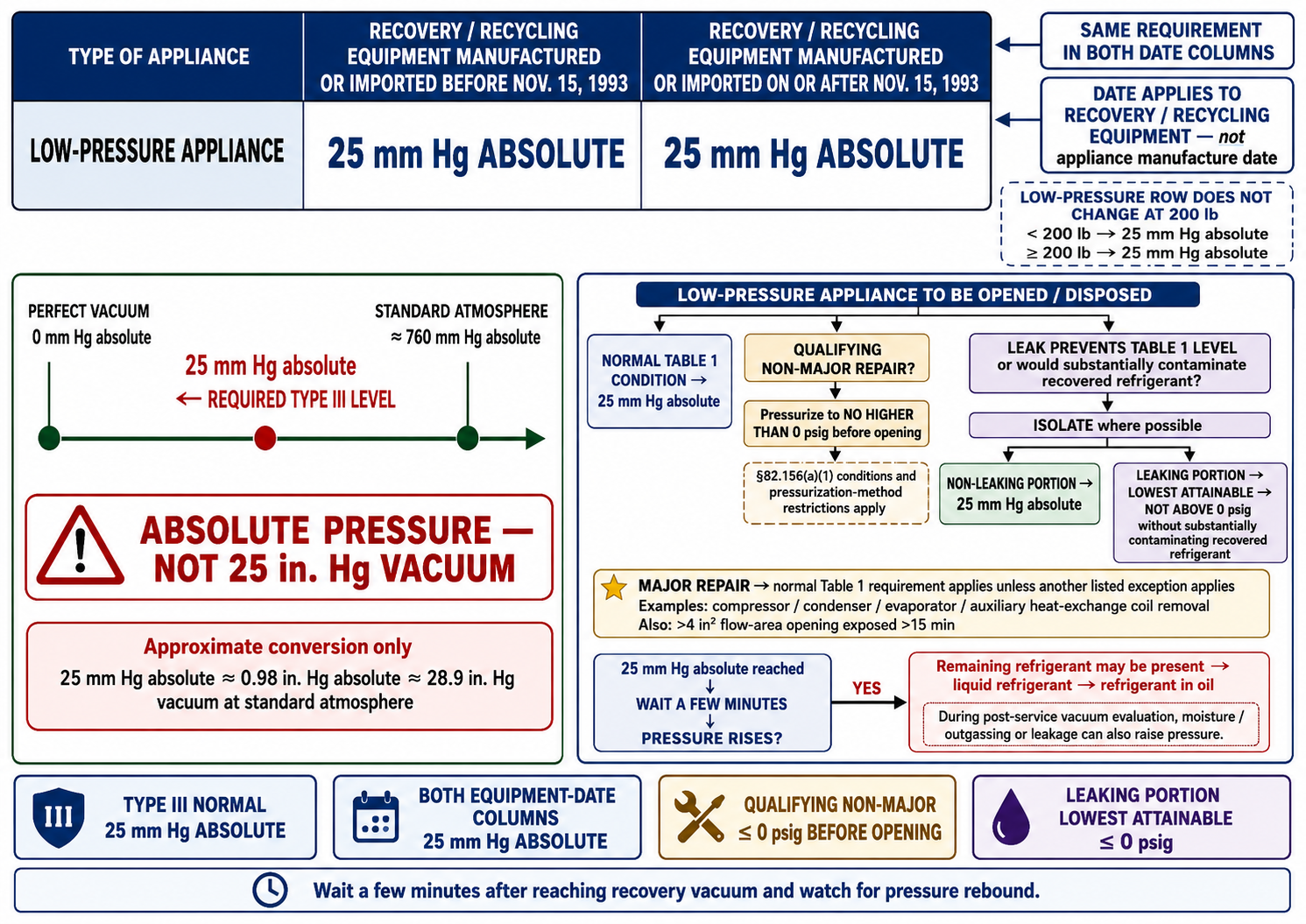
Figure 9.9.1 - Current Section 608 low-pressure evacuation requirement and the principal Type III exceptions.
AI-generated instructional figure: It may contain visual inaccuracies. Use the accompanying lesson text and cited authoritative sources to verify technical and regulatory details.
EPA 608 Exam Focus
Current Type III Evacuation Value
Memorize:
LOW-PRESSURE APPLIANCE
→ 25 mm Hg ABSOLUTE
Equipment Date
PRE-NOV. 15, 1993 RECOVERY EQUIPMENT
→ 25 mm Hg absolute
ON/AFTER NOV. 15, 1993 RECOVERY EQUIPMENT
→ 25 mm Hg absolute
The date applies to the recovery/recycling equipment.
Charge Size
< 200 lb
→ 25 mm Hg absolute
≥ 200 lb
→ 25 mm Hg absolute
under the normal low-pressure Table 1 condition.
Pressure-Rise Check
REQUIRED VACUUM REACHED
→ WAIT A FEW MINUTES
→ CHECK FOR PRESSURE RISE
EPA’s key Type III interpretation:
PRESSURE RISE
→ LIQUID REFRIGERANT MAY REMAIN
or
→ REFRIGERANT MAY REMAIN IN OIL
Major Repair
MAJOR REPAIR
→ NORMAL TABLE 1 REQUIREMENT
→ 25 mm Hg absolute
unless another listed exception applies.
Qualifying Non-Major Repair
NON-MAJOR
+
regulatory conditions satisfied
→ pressurize to NO HIGHER THAN 0 psig
before opening
Leaking Appliance
LEAK PREVENTS 25 mm Hg absolute
↓
ISOLATE WHERE POSSIBLE
↓
NON-LEAKING → 25 mm Hg absolute
LEAKING → lowest attainable, not above 0 psig
High-Priority Unit Trap
25 mm Hg ABSOLUTE
is correct.
25 in. Hg VACUUM
is incorrect.
Common Mistakes and Confusing Points
Mistake 1: Reading 25 mm Hg Absolute as 25 Inches Hg Vacuum
The unit and reference are both different.
The federal Type III value is:
25 millimeters of mercury ABSOLUTE
Mistake 2: Using a Type II Evacuation Value for a Low-Pressure Chiller
Do not use:
- 4 in. Hg vacuum.
- 10 in. Hg vacuum.
- 15 in. Hg vacuum.
for the normal Type III low-pressure row.
Use:
25 mm Hg absolute
Mistake 3: Changing the Type III Value at 200 Pounds
The 200-lb distinction does not change the low-pressure Table 1 endpoint.
Mistake 4: Treating the November 15, 1993 Date as the Chiller Manufacture Date
It is the recovery/recycling equipment manufacture/import date.
Mistake 5: Assuming Reaching 25 mm Hg Absolute for One Instant Means Recovery Is Complete
Wait a few minutes and observe whether pressure rises.
Additional refrigerant can still be vaporizing from liquid or oil.
Mistake 6: Assuming Every Pressure Rise Proves an External Leak
Pressure rise can also result from:
- Remaining liquid refrigerant.
- Refrigerant leaving oil.
- Moisture/outgassing.
Determine the cause.
Mistake 7: Assuming a Slow Rise to a Plateau Proves Moisture
It can be consistent with moisture or outgassing, but the trend is diagnostic evidence rather than absolute proof.
Mistake 8: Applying the Non-Major 0-psig Provision to a Major Repair
The limited provision is for qualifying non-major work under the stated regulatory conditions.
Major repair normally requires the Table 1 endpoint unless another exception applies.
Mistake 9: Assuming Every Non-Major Repair Automatically Uses Nitrogen
Nitrogen use is restricted by the current low-pressure non-major pressurization rules.
Mistake 10: Treating a Leak as Permission to Stop Recovery Above 0 psig
The leaking portion must still be evacuated to the lowest attainable level without substantial contamination, and that level may not exceed 0 psig.
Mistake 11: Leaving a Non-Leaking Section at 0 psig Because Another Section Leaks
If isolation is possible, the non-leaking section must still be evacuated to the prescribed Table 1 level.
Mistake 12: Confusing 25 mm Hg Absolute With a 500-Micron Dehydration Target
They serve different purposes.
25 mm Hg absolute is the current Type III Section 608 refrigerant-removal endpoint under the normal Table 1 condition.
A deeper manufacturer dehydration target is a separate technical service requirement.
Mistake 13: Confusing Type III Pressure Numbers
Keep the major Module 9 numbers separated:
| Number | Meaning |
|---|---|
| 25 mm Hg absolute | Normal Type III Section 608 evacuation requirement |
| 0 psig maximum | Qualifying non-major opening / leaking-component exception boundary |
| 5 psig maximum | Oil-change provision from Section 9.7 |
| 10 psig | Type III leak-test maximum exam value and traditional recovery-unit cutout in their respective contexts |
| 15 psig | Traditional low-pressure recovery-vessel rupture-disc exam value |
Always identify the procedure before selecting the number.
Concept-Check Questions
Question 1
What is the current Section 608 Table 1 evacuation requirement for a normal low-pressure appliance?
A. 4 inches Hg vacuum
B. 10 inches Hg vacuum
C. 15 inches Hg vacuum
D. 25 mm Hg absolute
Question 2
Which statement correctly interprets 25 mm Hg absolute?
A. It means 25 inches of mercury below atmospheric pressure.
B. It is an absolute pressure of 25 millimeters of mercury above perfect vacuum.
C. It means the appliance must be at 25 psig.
D. It is another way to state 500 microns exactly.
Question 3
A low-pressure chiller is being recovered with recovery equipment manufactured after November 15, 1993. How does its normal Table 1 requirement compare with the requirement when pre-November-15-1993 recovery equipment is used?
A. Post-1993 equipment requires 15 in. Hg vacuum, while older equipment requires 4 in. Hg vacuum.
B. Post-1993 equipment requires 10 in. Hg vacuum, while older equipment requires 0 psig.
C. Both require 25 mm Hg absolute.
D. The requirement depends only on whether the chiller was manufactured before 1993.
Question 4
After reaching the required Type III recovery vacuum, why should the technician wait a few minutes and observe the pressure?
A. A pressure rise can indicate that liquid refrigerant or refrigerant dissolved in oil still remains.
B. The wait converts refrigerant vapor into nitrogen.
C. The wait determines the recovery cylinder’s DOT test date.
D. Pressure must always rise to atmospheric pressure before service.
Question 5
Which repair is considered major under the current Section 608 definition?
A. Replacing an external cabinet label
B. Removing the evaporator from the appliance
C. Tightening an external mounting bolt
D. Replacing external pipe insulation
Question 6
A low-pressure appliance qualifies for the current non-major repair exception under § 82.156(a)(1). To what pressure must the appliance be pressurized before it is opened?
A. No higher than 0 psig
B. Exactly 5 psig
C. Exactly 10 psig
D. 25 psig
Question 7
A leak prevents a low-pressure appliance component from being evacuated to 25 mm Hg absolute. The leaking component cannot be isolated any further, and deeper evacuation would substantially contaminate the refrigerant being recovered. What does the current rule require for that leaking component?
A. Leave it at any pressure because a leak exists.
B. Evacuate it to the lowest attainable level without substantial contamination, and the level may not exceed 0 psig.
C. Pressurize it to 10 psig and open it immediately.
D. Vent the remaining refrigerant to atmosphere.
Question 8
A technician isolates a repaired low-pressure chiller after evacuation and observes a continuing pressure rise. Which statement is most accurate?
A. The rise proves with certainty that only moisture is present.
B. The rise proves with certainty that only an external leak is present.
C. The rise can result from remaining refrigerant, refrigerant leaving oil, moisture/outgassing, or leakage, so the cause must be evaluated.
D. Any pressure rise means the appliance automatically satisfies the Section 608 requirement.
Answers and detailed explanations will be provided in
9.15 - Answers and Explanations.md.
Section Summary
The current Section 608 evacuation requirement for a normal low-pressure appliance is:
25 mm Hg ABSOLUTE
This value is the same when using recovery/recycling equipment manufactured or imported:
BEFORE NOV. 15, 1993
or:
ON / AFTER NOV. 15, 1993
The date applies to the recovery/recycling equipment, not the chiller.
The normal low-pressure row also does not change at a 200-lb refrigerant charge.
The most important unit distinction is:
25 mm Hg ABSOLUTE
≠
25 in. Hg VACUUM
After the required recovery vacuum is reached:
WAIT A FEW MINUTES
→ OBSERVE PRESSURE
A pressure rise can indicate:
REMAINING LIQUID REFRIGERANT
or:
REFRIGERANT LEAVING OIL
During broader post-service vacuum evaluation, moisture/outgassing and leakage can also cause pressure rise.
For a normal major repair:
25 mm Hg absolute
applies unless another regulatory exception is available.
For a qualifying non-major repair:
PRESSURIZE TO NO HIGHER THAN 0 psig
BEFORE OPENING
with the current pressurization-method restrictions.
If leaks prevent the normal Table 1 level:
ISOLATE WHERE POSSIBLE
↓
NON-LEAKING PORTION
→ 25 mm Hg absolute
↓
LEAKING PORTION
→ LOWEST ATTAINABLE
→ NOT ABOVE 0 psig
The next section addresses the major safety provisions associated with Type III chillers and machinery rooms:
Section 9.10 - Type III Safety and Machinery Rooms.
References
Current Regulatory and EPA Sources
-
U.S. Environmental Protection Agency, Required Level of Evacuation of Appliances, current low-pressure Table 1 value, accessed August 13, 2026.
-
U.S. Environmental Protection Agency, Stationary Refrigeration Service Practice Requirements, current evacuation requirements, exceptions, and oil-change context, accessed August 13, 2026.
-
U.S. Environmental Protection Agency, Section 608 Test Topics, current Type III Recovery Requirements and pressure-rise check topics, accessed August 13, 2026.
-
Electronic Code of Federal Regulations, 40 CFR § 82.156 - Proper Evacuation of Refrigerant From Appliances, current Table 1, non-major exception, and leaking-appliance exception, accessed August 13, 2026.
-
Electronic Code of Federal Regulations, 40 CFR § 82.152 - Definitions, current definition of major maintenance, service, or repair, accessed August 13, 2026.
Project Teaching and Technical References
-
International Training Institute for the Sheet Metal and Air Conditioning Industry, EPA Section 608 Study Guide, Type III recovery requirements and low-pressure evacuation review material. Used as an exam-preparation cross-check only where consistent with current EPA/eCFR requirements.
-
Rex Miller and Mark R. Miller, HVAC Licensing Study Guide, 3rd ed., supplemental low-pressure recovery, vacuum, and service-practice concepts.
-
Section 9.4 - Low-Pressure Leak Detection and Pressurization.